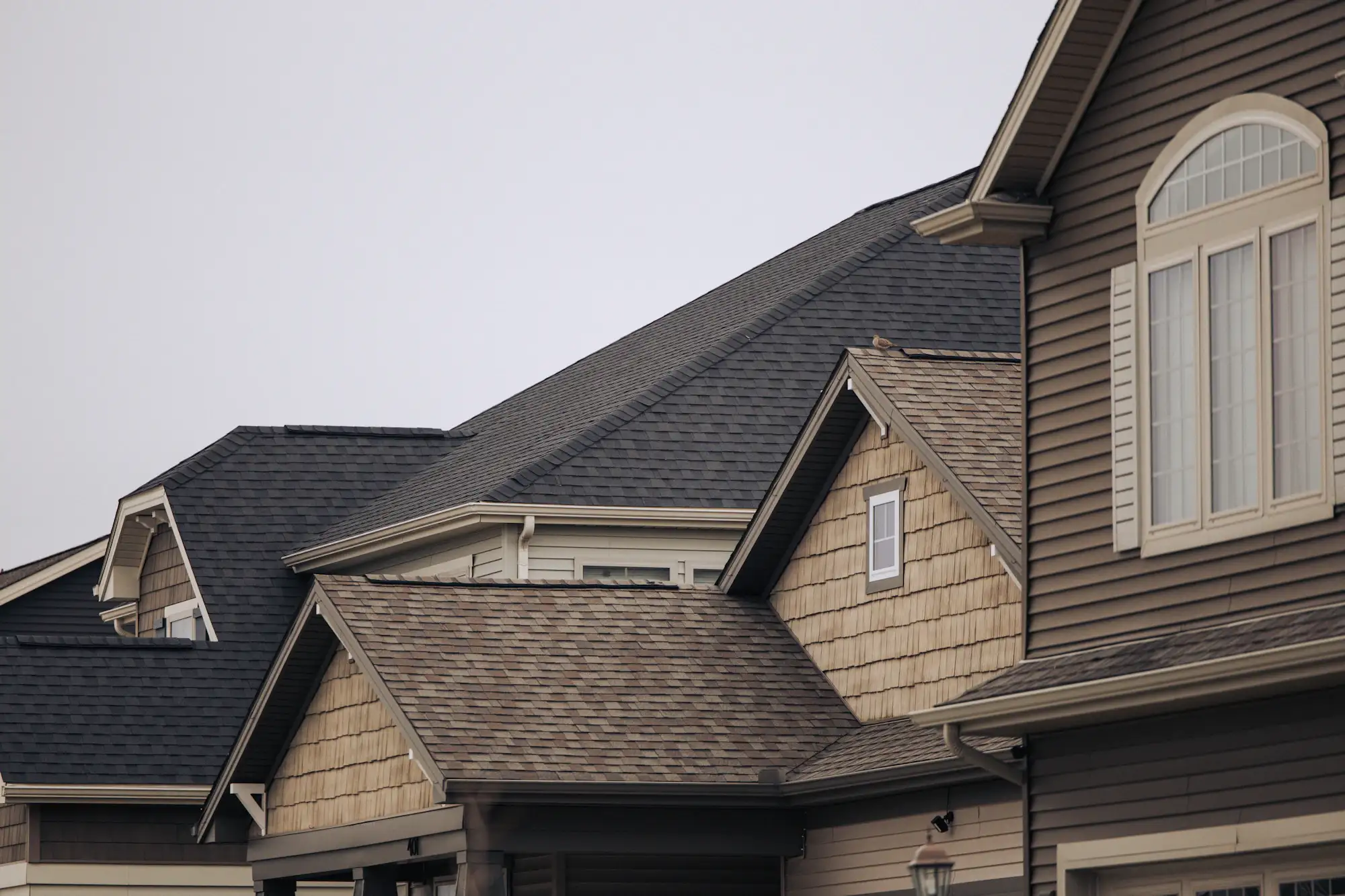
Shingle roof replacement · Lee County, Florida
Shingle roof
replacement, done
to the wind code.
Asphalt shingle is the most common roof in Lee County and the one most often installed badly. The shingle itself is rarely the problem. What sits under it, how it's fastened and what happens at the edges — that's what decides whether it's still on the house after a storm.
Before you compare quotes: two shingle roofs can differ by thousands and look identical from the street. The difference is almost always in the underlayment, the nailing pattern and the flashing detail. This page tells you what to look for on the quote in your hand.
- Free, with no obligation
- Written report with photos
- Office on Cypress Lake Drive
When it's time
How a shingle roof actually ends.
Rarely all at once. Shingle roofs fail in a sequence, and you can usually tell where yours is in it.
Granules go first
Those granules are the shingle's sunscreen. They wash into the gutters a few at a time for years, then the asphalt underneath starts taking direct UV and the mat begins to harden. Once you can see shiny black patches across a slope, the clock is short.
Then the seal strips let go
Every shingle is glued to the one below by a heat-activated strip. Age, heat cycling and foot traffic break that bond, and an unsealed shingle is a flap of tab waiting for the right gust. This is why storm damage often shows up on a roof that looked fine.
Edges and penetrations leak before the field does
Valleys, pipe boots, the wall-to-roof junction, and the first course at the eave. A roof can have a decade left in the middle of the slope and be leaking at a $40 boot. That's a repair, not a replacement — and it's worth knowing the difference before anyone quotes you for a whole roof.
Finally the mat goes brittle
Walk a roof at this stage and shingles crack underfoot instead of flexing. There is no repairing this — every tab lifted to fix one thing damages two more. It is the clearest single sign that a roof is genuinely finished.
Algae streaking is not one of these. Those black vertical stains are a cyanobacteria feeding on limestone filler in the shingle. It's ugly and it holds heat, but it is not structural and it is not a reason to replace a roof. Anyone who opens with the streaks is selling.
The part under the shingles
In Florida the underlayment is the roof.
Shingles are a rain screen and a wear surface. When a storm takes them off — and in a bad enough storm it will — whatever is beneath them is the only thing between weather and your ceiling.
A secondary water barrier is required, and there are three legal ways to do it
Under the 2023 Florida Building Code, 8th Edition, removing and replacing a roof covering triggers a secondary water barrier (R908.7.2; 706.7.2 in the Existing Building volume). R905.1.1.1 permits three methods: full deck coverage with a self-adhering polymer-modified bitumen sheet to ASTM D1970; 3¾-inch strips taped over the deck joints with approved underlayment above; or a two-layer system to ASTM D226 Type II, D4869 or D8257 fastened at no more than 12 inches on centre.
All three pass inspection. They do not perform alike in a storm. Ask which one is in your quote, in those words — and if the answer is vague, that tells you something.
The deck gets re-fastened while it's open
Strip a wood deck in the wind-borne debris region and deck attachment requirements are triggered (706.8). Re-nailing a 1990s deck to today's schedule is a genuine structural upgrade, and it can only happen on the one day of a roof's life when the covering is off. Check it's on the quote rather than assumed.
Your design wind speed is not a county figure
It's read per address from the ASCE 7-22 map at Risk Category II for an ordinary house. Homes a few miles apart sit at different speeds. Where the design speed is 170 mph or above, the code also requires metal caps on the underlayment fasteners — a small detail, but a reliable test of whether a contractor is reading the code or repeating what they heard.
Specification
Five lines to look for on a shingle quote.
If a quote is one paragraph and a number, it isn't a quote, it's a price. These are the lines that should be on it.
The named underlayment and barrier method
Not "premium synthetic underlayment". A product and a method, matched to one of the three the code permits. This single line is usually the largest honest difference between two quotes.
The nailing pattern
Manufacturers publish a high-wind fastening pattern — six nails per shingle rather than four, placed in the nailing zone, driven flush and not overdriven. A nail through the seal strip or above the zone is a shingle that will lift. Ask which pattern is being used, and ask for it in writing.
Starter course and drip edge, at eaves and rakes
Trimmed-down field shingles used as a starter strip put the adhesive in the wrong place, and a roof without proper rake starter peels from the gable end inward. Drip edge is cheap, required, and routinely left off. Look for both by name.
Flashing: replaced, not reused
Step flashing at walls, counter-flashing, valley metal, pipe boots. Reusing old flashing on a new roof is the most common corner cut in this trade, because it's invisible the day the job finishes and it leaks three years later. Everything that penetrates the roof should be new, and the quote should say so.
Ventilation, stated as a system
Intake at the soffit and exhaust at the ridge have to balance. Adding ridge vent without opening the soffits does very little, and mixing ridge vents with powered fans can pull air backwards through the attic. Inadequate ventilation voids more shingle warranties than manufacturing defects do — which tells you how seriously the manufacturers take it.
Print this section and put it next to the quote. Every line on it is something a good contractor is happy to answer and a careless one would rather not be asked. You don't need to know roofing to use it — you just need to ask.
Wind ratings
What a "130 mph shingle" does and doesn't mean.
Asphalt shingles are wind-tested to two ASTM standards, and the packaging usually quotes whichever sounds better. The rating describes how the shingle performed on a test deck, installed exactly as the manufacturer specifies — correct nail count, correct nail placement, seal strips fully bonded.
That last part is the catch. The rating is a property of the installation, not of the shingle sitting in the packet. A high-rated shingle nailed four-up and overdriven is a low-rated roof, and no label on the bundle changes that.
It also isn't the same number as your design wind speed. The test standards and the ASCE 7 wind map measure different things in different ways, so a shingle rating and a design speed can't be compared directly — which is exactly what a lot of marketing invites you to do.
What matters on your house: the shingle carries the classification your specification calls for, and it is installed to the high-wind instructions that the classification depends on.
A fair question to ask any roofer. "Which wind classification is this shingle, and are you installing it to the manufacturer's high-wind instructions?"
The answer should be immediate and specific. If it's a number with no standard attached, you've learned something.
Cost
Why shingle quotes differ so much.
We don't publish prices — a price for a roof nobody has looked at is a guess with a dollar sign on it. But the variables are not a secret.
Squares and pitch
Roofing is priced per square — 100 square feet of roof surface, not floor area. A steep roof has more surface than its footprint suggests and needs fall protection on top of that, so it costs more per square for reasons unrelated to materials.
Layers coming off
Tear-off and disposal is labour and landfill weight. Two layers is close to double the work before a single new shingle goes on.
How cut-up the roof is
Valleys, dormers, skylights, chimneys, dead valleys against a wall. A plain gable and a complicated hip roof of identical area are not the same job — the flashing detail is where both the labour and the future leaks live.
Three-tab versus architectural
Architectural (laminated) shingles are heavier, carry higher wind classifications and last longer in this climate. Three-tab is cheaper on the day. On a Florida roof that difference tends to close quickly.
What the deck turns out to be
Nobody can price rotten plywood before the roof is open. Insist on a per-sheet rate in the quote — that way, if rot is found, the cost is already agreed and it isn't a negotiation held while you're standing in the driveway.
Questions
Shingle replacement, answered straight.
How long does a shingle roof last in Florida?
Less than the number on the packet, and it varies more than anyone selling you one will admit. Sun exposure, attic ventilation, pitch, and how well it was installed all move it substantially. Rather than quote you an average, we'll get someone out to look and you'll get the findings in writing, with photographs.
Can new shingles go over the old ones?
Don't accept one. A layover hides the deck so nobody inspects or re-fastens it, and it makes satisfying the secondary water barrier requirement properly impossible. It's cheaper on the day and worse in every other respect. If a quote includes a layover, ask how they intend to meet R908.7.2.
Three-tab or architectural?
Architectural, on almost any Florida roof. They're heavier, carry higher wind classifications, handle heat cycling better and look considerably less flat. Three-tab still has a place on outbuildings and tight budgets — we'd just rather you chose it knowing what you're trading.
How long does the job take?
Most single-family shingle roofs here run two to four days, weather permitting. A competent crew doesn't tear off more than it can dry in the same day, so the house is never open overnight — once the barrier and underlayment are down it's watertight with or without shingles. It's a fair thing to ask about before work starts.
What about the algae streaks?
Cosmetic. If the streaking bothers you and you're replacing anyway, algae-resistant shingles use copper-bearing granules that slow it considerably. It is not, on its own, a reason to replace a roof.
What if my roof can be repaired instead?
Then that's what the report should say, and we'd rather it did. A boot, a valley and some flashing is a very different job from a re-roof, and plenty of roofs that look finished from the street aren't.
What do I do about insurance?
If a covered event caused the damage there may be a claim; wear and age are not covered events on any policy we've seen. Florida law is specific about who may advise or negotiate on a claim, so that conversation belongs between you and your adjuster — what a thorough inspection gives you is documentation solid enough to bring to it.
Should I get a wind mitigation inspection afterwards?
Yes — and sooner rather than later. The features you just paid for only reach your carrier once they're documented on form OIR-B1-1802. A new roof with no form filed is money sitting on the table.
The rest of the cluster
A different covering is a different conversation.
Each material fails in its own way and carries its own set of questions worth asking before you sign anything. These cover the other three.
Metal roof replacement
Standing seam or exposed fastener, and the difference decides what you are maintaining for the next thirty years. Coastal corrosion, finish grades, and what a system approval actually covers.
Tile roof replacement
The tile is a rain screen; the underlayment beneath it is the waterproofing, and it is what expires. Often a lift-and-relay rather than a replacement.
Flat roof replacement
A flat roof is not flat, and most low-slope failures in Florida are drainage problems wearing a membrane costume. Ponding, tapered insulation, and attachment method.
Where we work
Getting a shingle roof replacement quoted in Lee County.
Four cities, and the roofs in them do not age the same way — nor does the permit go to the same desk. Each page covers what is specific to that one.
Fort Myers roofing
Home base, on Cypress Lake Drive.
Cape Coral roofing
Open canal lots, so edges and corners take the wind first.
Estero roofing
Mostly tile, and mostly inside communities with a say over it.
Bonita Springs roofing
Closest to the Gulf, so corrosion arrives early.
Outside these four? Call and we will tell you straight whether we can reach you on the day you need us, rather than claim a service radius we cannot cover. All service areas.
Book it
Start with the inspection, not the quote.
Three short steps and we'll arrange it. The inspection is free, you keep the photographs and the written report, and a fair number of them come back saying the roof has years left.
Get it in writing before you commit.
About an hour on site, photographs of every problem area, and a plain answer about whether this is a repair, a replacement, or nothing at all yet.
Get an inspection arranged