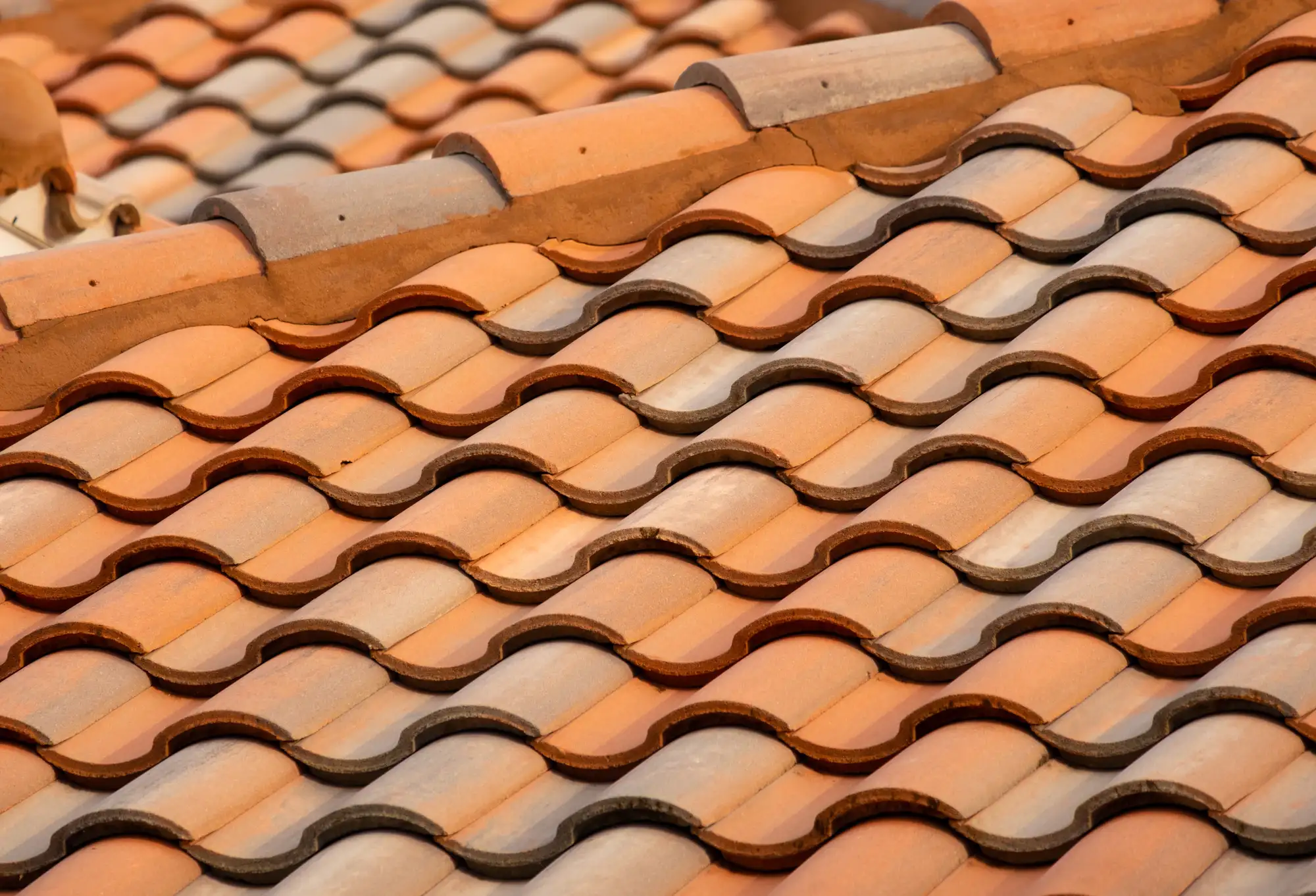
Tile roof replacement · Lee County, Florida
The tile is
usually fine.
It's what's under it.
Concrete and clay tile outlast almost everything else on a Florida roof. The underlayment beneath them does not. That single fact shapes every honest conversation about a tile roof — including the one about whether you need a new roof at all, or the same tiles put back down on a new membrane.
The question worth asking first: "is this a re-roof, or a lift-and-relay?" They are different jobs at different prices, and on a lot of Lee County tile roofs the second one is the right answer. A contractor who never raises the option isn't offering it.
- Free, with no obligation
- Written report with photos
- Office on Cypress Lake Drive
How tile roofs fail
Water gets in long before a tile breaks.
A tile roof is a two-part system, and people only ever look at the half they can see.
The tile is a rain screen, not a waterproof layer
Wind-driven rain goes past tile routinely — it always has, by design. The membrane underneath is what actually keeps the house dry, and the tile's job is to take the sun and the impact so that membrane doesn't have to. When people say a tile roof lasts fifty years they're describing the tile. The waterproofing has a much shorter life.
So the underlayment is the thing with the expiry date
Heat cycling and UV that leaks through the gaps age it from above; trapped moisture ages it from below. It becomes brittle, tears at the fasteners, and stops sealing around the nails holding the battens or the tile. The first symptom is usually a stain on a ceiling somewhere well away from the actual entry point, because water travels along battens before it drops.
Foot traffic breaks more tile than weather does
Every trade that goes up there — satellite, AC, gutters, pressure washing, solar — stands on tile that was never meant to be walked casually. Cracked and slipped tiles let far more water through than the system is designed to shed, and a cracked tile in a valley is worth more damage than a cracked tile in the middle of a slope. If several trades have been on your roof over the years, that's worth having looked at.
Then there's what the last repair did
Tile roofs attract bad repairs, because doing it properly means lifting courses and doing it badly means a tube of sealant. Mortar smeared over a crack, foam squirted under a slipped tile, a valley "fixed" with roof cement — these are visible from a ladder and they tell you how the roof has been looked after.
The decision
Lift and relay, or full replacement?
This is the conversation that decides the cost, and it turns on the condition of the tile rather than the condition of the roof.
Lift and relay — the tile comes off and goes back on
Tiles are lifted carefully, stacked on the roof or on the ground, the old underlayment is stripped, the deck is inspected and re-fastened as required, a new membrane goes down, and the original tiles are re-laid with a percentage of breakage replaced from stock.
It costs materially less than a full replacement because you aren't buying a roof's worth of tile, and it resets the clock on the layer that actually failed. It only works where the tile itself is sound and where enough matching replacements can be sourced for the inevitable breakage.
Full replacement — new tile too
The right answer when the tile is spalling, widely cracked, or a profile nobody makes any more in a quantity you can't match. Also the right answer if you want a different look, or if the structure is being changed.
Restoration, when the membrane still has years in it
If the underlayment is sound and the trouble is on the surface, such as cracked and slipped tile, loose ridge and hip, and tired seals at the details, neither of the above is needed yet. Cleaning, tile replacement and re-bedding is a much smaller job. What tile roof restoration covers.
The breakage rate is the number to pin down
Some tile always breaks during a lift — older and more brittle tile breaks more. A quote should say what breakage allowance is assumed and what happens if it's exceeded, because "we'll see how it goes" on a tile roof is an open cheque. Ask for the figure and ask where replacement tile is coming from.
Specification
What should be written on a tile quote.
The underlayment, by name and by method
This is the entire point of the job. A two-ply system, or a self-adhered high-performance membrane, behaves very differently over a thirty-year horizon — and since you're paying to handle every tile on the roof either way, spending less on the layer you're doing all this work to replace is a strange saving. The secondary water barrier requirement applies as on any Florida re-roof (R908.7.2, methods at R905.1.1.1).
The attachment method for the tile
Mortar set, adhesive foam, or mechanically fastened with screws or nails — each is approved as a system under Florida Product Approval, with defined uplift performance, and each behaves differently. Foam has become common because it's quick and performs well; it is also unforgiving of a poorly prepared surface. The quote should state which method and which approval covers it.
Battens, and whether they drain
Where battens are used, water that gets past the tile has to run down the membrane and out — battens laid flat across the slope can dam it. Elevated or counter-battened arrangements let it drain. On a roof whose whole defence is the membrane, letting water sit on that membrane is the wrong answer.
Valleys, and what metal is in them
Tile valleys carry a lot of water and they're the first place a tile roof leaks. Valley metal should be new, adequately wide, and corrosion-appropriate for your distance from salt water. Reusing old valley metal under new tile is the definition of a false economy.
Ridge, hip and the mortar question
Traditional mortar-bedded ridges crack and shed over time in this climate. Modern dry-fix or adhesive-set ridge systems are more durable and allow ventilation at the ridge. If the quote is for mortar because that's what's up there now, it's worth asking whether that's the best available answer or just the familiar one.
Two things specific to tile
Weight, and the matching problem.
Weight. Concrete tile is heavy — several times the weight of an asphalt shingle roof per unit area. A house framed for tile carries it fine. A house framed for shingle does not, and going from shingle to tile is a structural question that needs an engineer before it's a roofing question. Going the other way, tile to shingle, is straightforward structurally but changes the look of the house and, in some neighbourhoods, needs approval.
Matching. Tile profiles and colours are discontinued constantly. If a storm damages part of a tile roof and the tile is no longer made, you have a dispute on your hands about whether the insurer owes you a repair that won't match or a replacement that will. Florida law addresses matching for repairs, but how it's applied to roofs is contested and carriers do not concede it readily.
The practical protection is documentation: know your tile's manufacturer, profile and colour before you need them, and keep any spare tile that comes off during work. A pallet of matching tile in the side yard is worth more than it looks the day a claim starts.
Already hunting for a match? How matching discontinued, reclaimed and salvaged roof tile works, in the order worth trying, and when it stops being worth the money.
Before anyone quotes you. Find out what tile is on your roof. The profile is often stamped on the underside, and a single tile lifted in a discreet spot answers a question that will otherwise cost you time and money later.
If you're in an HOA, check the approved colour and profile list before you choose anything.
Questions
Tile roofing, answered straight.
My tile roof is leaking. Do I need a whole new roof?
Often not. A single leak on an otherwise sound tile roof is usually a cracked tile, a failed valley, or a penetration — all repairable. What matters is the age and condition of the underlayment, because a roof that needs its fourth repair in three years is telling you the membrane has gone, not the tile. That's what an inspection is for.
Can you repair just part of a tile roof?
Yes, and it's frequently the right call. Florida's 25% rule governs when repairing part of a roof pulls the wider assembly up to current code, and there's an exception for roofs built to the 2007 code or later. It's routinely misquoted by people who'd prefer to sell a replacement.
How long does the underlayment actually last?
Less than the tile and more than a shingle roof — but the range is wide enough that quoting an average would be misleading. Ventilation, sun exposure, what grade of membrane went down last time and how well it was detailed all move it. The honest way to find out is to look, which is why the inspection matters more on tile than on any other roof type.
Clay or concrete?
Clay holds colour essentially permanently because the colour is the material; concrete is pigmented and fades, more noticeably on darker colours. Clay costs more. Concrete is what most Lee County tile roofs are, and it's a perfectly good product — just expect it to look different in fifteen years.
Can I walk on my tile roof?
Best not to. There are correct places to step and most people don't know where they are, and a cracked tile is an invisible leak until it isn't. If a trade needs roof access, that's a reasonable thing to ask them to be careful about — and worth inspecting afterwards.
How long does a tile job take?
Longer than shingle, and a lift-and-relay is longer still because every tile is handled twice. Weather matters more too, since the roof is genuinely open between strip and dry-in. A realistic schedule should be in the quote.
Is there an insurance angle?
If a covered event caused the damage, potentially. Age and wear are not covered events. Florida law is specific about who may advise or negotiate on a claim, so that conversation belongs between you and your adjuster — what a thorough inspection gives you is documentation solid enough to bring to it.
Should I get a wind mitigation inspection afterwards?
Yes. Tile attachment method and the secondary water barrier are both documented on form OIR-B1-1802, and they're exactly the sort of detail that earns credits with a carrier once it's on paper.
The rest of the cluster
A different covering is a different conversation.
Each material fails in its own way and carries its own set of questions worth asking before you sign anything. These cover the other three.
Shingle roof replacement
The common one, and the one where the underlayment specification matters more than the shingle brand. Three legal ways to build the secondary water barrier; they do not perform alike.
Metal roof replacement
Standing seam or exposed fastener, and the difference decides what you are maintaining for the next thirty years. Coastal corrosion, finish grades, and what a system approval actually covers.
Flat roof replacement
A flat roof is not flat, and most low-slope failures in Florida are drainage problems wearing a membrane costume. Ponding, tapered insulation, and attachment method.
Where we work
Getting a tile roof quoted in Lee County.
Four cities, and the roofs in them do not age the same way — nor does the permit go to the same desk. Each page covers what is specific to that one.
Fort Myers roofing
Home base, on Cypress Lake Drive.
Cape Coral roofing
Open canal lots, so edges and corners take the wind first.
Estero roofing
Mostly tile, and mostly inside communities with a say over it.
Bonita Springs roofing
Closest to the Gulf, so corrosion arrives early.
Outside these four? Call and we will tell you straight whether we can reach you on the day you need us, rather than claim a service radius we cannot cover. All service areas.
Book it
Find out whether it's the tile or the membrane.
Three short steps and we'll arrange it. The inspection is free, you keep the photographs and the written report, and on tile roofs it frequently comes back recommending a relay rather than a replacement.
Get it in writing before you commit.
About an hour on site, photographs of every problem area, and a plain answer about whether this is a repair, a relay, a replacement, or nothing at all yet.
Get an inspection arranged